
What are the Van Allen radiation belts?
At first glance, the area between the Earth and the moon is nothing but empty space, but this is not true. Between us and the moon there is a zone of deadly radiation known as the Van Allen belt. This belt has extremely high radiation levels, far higher than a fatal dose for humans and is a massive obstacle in travel beyond Earth. So, how did astronauts ever manage to get to the moon?
Deadly discovery
The Van Allen radiation belt was discovered by astrophysicist James Van Allen in 1958. He and his team designed a radiation detection device that was sent to space on the satellite Explorer I, which proved the existence of two belts of radiation around the Earth. Later probes and satellites with other instruments designed by him and his team showed that there was not one but two belts of radiation.
What are the Van Allen belts?
Van Allen and his team confirmed a long-standing hypothesis that the Earth’s magnetic field could trap radiation produced by the sun. Scientists had at first thought that this radiation was only trapped in large amounts during magnetic storms, or increased activity in the magnetic field, but Van Allen proved that two belts of extremely high radiation existed around the Earth. The inner belt is made up of mostly protons, positively charged particles from cosmic rays. The outer belt is made up of mostly electrons, negatively charged particles from solar wind.
Getting through the belts
These belts had radiation levels far above what is considered deadly for humans and this was a major obstacle for travel beyond Earth. Even to get to the moon, astronauts would have to pass through the belts. However, Van Allen also discovered that the belts were not the same everywhere, there were parts where the radiation was weaker. The Apollo missions managed to use this to send astronauts to the moon by plotting the route of the spacecraft to spend as little time in the belt as possible. For example, Apollo 11 spent only 52 minutes passing through the belts which allowed the astronauts to get through alive.
The latest mission
NASA’s recent manned lunar mission, Artemis II, faced the same obstacle. No radiation shielding could be created that would both withstand the radiation levels and be light enough to send to space so NASA had to find another way. While Apollo managed to reduce the time spent in the belt, the Artemis crew spent a long time in orbit, testing systems and passed through the belt many times. To solve this problem, the crew were told to use food and supplies as barriers against any radiation. How effective this was is not known but the astronauts made it back alive so it appears to have worked.
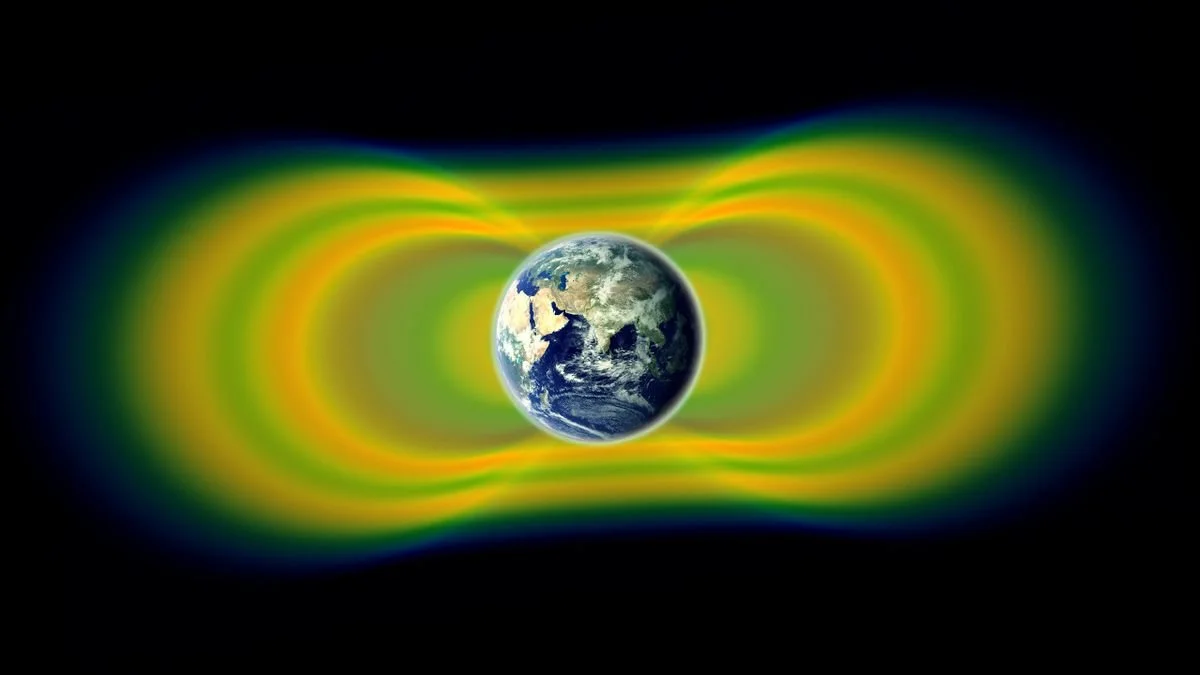
A model of the Van Allen radiation belts surrounding the Earth
