
Celebrating the life of Stephen Hawking
It is said that we are standing on the shoulders of giants: brilliant minds who pushed the boundaries of human knowledge to expand our understanding of the world. One such great mind is Stephen Hawking whose discoveries in astronomy and physics continue to shape the scientific world today. From his work on black holes to the discovery of Hawking radiation, he made some truly exceptional discoveries, but what is more, he did it all while enduring a terrible illness. So, what did his life look like and what led to his greatest discoveries?
Unremarkable beginnings
Stephen Hawking was born on January 8th, 1942, in St Albans, England, exactly 300 years after the death of Galileo Galilei. His parents were both research biologists, and this led him to pursue a career in science. He was drawn to physics despite his father urging him to study medicine because he believed that physics held the key to a deeper understanding of our world. After graduating from Oxford University, he went on to study cosmology at Cambridge, focusing on the universe as a whole.
A terrible disease
In 1963, soon after his 21st birthday, Hawking was diagnosed with Lou Gerhing’s disease, a disease that eventually makes a person unable to move, and was told he only had 2 years to live. It seemed unlikely that he would complete his doctorate, but he wasn’t the type of person to give up easily. Against all odds, he completed his doctorate and got his PhD in 1966.
Even though his condition continued to get worse, he found a way to turn this to his advantage by creating a whole new way of thinking about the world. He trained himself to visualize problems instead of writing out equations and it is said that this is what helped him make some of his greatest discoveries.
Working in one of science’s most bizarre areas
While all this was happening, Hawking found himself working in one of the strangest areas of science at the time, the study of black holes. An extreme version of one of Einstein’s theories suggested that there might exist points in space of infinite density that took up no space at all. Working alongside his colleague Roger Penrose, he proposed a new theory about these black holes that not only challenged the physics of the time, but supported the Big Bang theory. He also proposed a theory that black holes not only trapped anything that fell inside them but also radiated photons, or light. This was later detected and named Hawking radiation.
Bringing science to the general public
Later in his career, Hawking wrote several books that were designed to teach everyday people about science. His most famous work is A Brief History of Time, which sold almost 10 million copies. Alongside his other books on science, he and his daughter Lucy Hawking wrote a science fiction series, George and the Big Bang.
‘I’m not retiring’
Throughout all this, his condition continued to worsen. He relied on a computer to interpret the movement of the muscles in his cheek to speak, lost the ability to walk and eventually was unable to move almost completely. At the age of 67, he stepped down from a prominent post as a Cambridge professor of math but resolved to keep doing what he did best: thinking. Even though he was unable to work the same way most professors did, he continued researching and publishing papers.
A remarkable life
In March 2018, Stephen Hawking died at the age of 76. However, the discoveries he made continue to influence modern physics and cosmology and his books continue to inspire and educate scientists and the general public alike. Hawking was a scientist who refused to give up in the most dire of circumstances and his legacy continues to shape the world of science to this day.
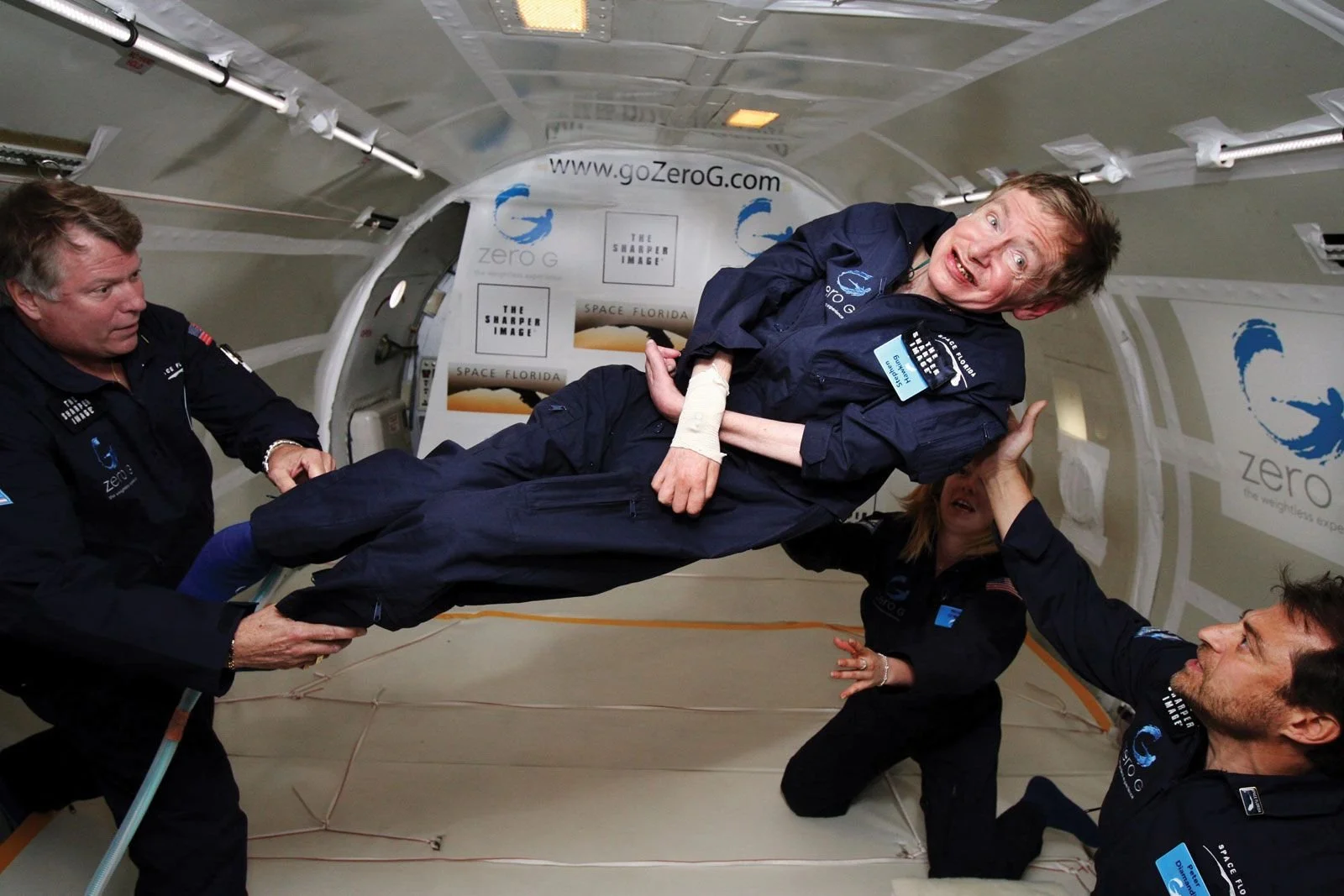
Stephen Hawking celebrates his 65th birthday in a NASA zero gravity plane
